Jhana Retreat Report

I went on a jhana retreat this year (2025), and this is a report of my three most important take-aways from that experience.

Just to quickly situate myself, I’ve been aware of jhana for about a decade, and I was around for the several tcot/tpot jhana discourses. I “tried it” at various points 2021-2023 and had some ✨sparkling✨ experiences, but I didn’t read the quasi-canonical Right Concentration until 2024… and concluded then that I probably hadn’t reached any jhanas. This year I finally went on a jhana retreat in the Brasington lineage. I reached jhana three days into the retreat, and indeed I had never had an experience like that before.

I’m not going to tell you how to jhana. I’m not a jhana teacher, and I am not qualified. My base assumption is that all of our psychologies and neurologies vary substantially and that you are probably not that much like me. If you are similar enough to me, however, and have a had a similar path to me, then you may identify yourself with my experiences, and what I have to say may be helpful for you.

The first important take-away was that access concentration is basically everything. It is the precondition for the next two, because without it there is not enough space for them. I won’t elaborate access concentration further; just read Right Concentration.

The second important take-away was how to relate to piti. In the experiences prior to the retreat I had been able to summon piti, feeling it mainly in my legs and somewhat also in my hands and face. In those experiences I virtually whipped it out of my body, with lashes of more More MORE! I’ve been describing it as pushing the piti. On the retreat I learned instead to sit with it, to allow it, to welcome it, to invite it for tea and a hangout. Access concentration gave me the ability to be a good, attentive host, rather than one trying to force the guest to play the game I wanted to play.

The third important take-away was how to relate to sukha. Even though sukha is primarily associated with second jhana, it is not restricted to being linearly after piti. In the experiences prior to the retreat I had been focused on attaining first jhana, ignoring sukha entirely, assuming I would work on it after I had checked the first jhana box. What I found in the retreat was that sprinkling in a little sukha in the prepatory access concentration phase (helped along with a little metta or a little smile), made relaxing equanimously into the piti much easier.

On a technical level, what I learned to practice on the retreat was access concentration on the breath, with a fully breath-entangled transition to access concentration on piti and sukha. The Brasington instruction is to transition discretely, but I found that doing it entangledly worked better for me. What I mean is that I would start with breath itself and then gradually find the susurrations of piti and sukha (usually not at the same time) that are breath-dependent—that happen before and in and after the breath—and gradually let my access concentration be on those susurrations alone, forgetting about the breath. Enough breaths and this eventually led to what my teacher would offhandedly call the “pillar of piti” once at the end of retreat (or was it “column of piti”? idk same visual), which is the perfect concept of first jhana: a bright rush of energy flowing upwards and skywards through and out of the body.

I like second jhana more than first jhana. First is exhilarating, but second is wonderful. Sometimes I just want to skip the piti party entirely. Still, just like rest after exercise is so much deeper than rest without having exercised, so is sukha after first jhana so much deeper than sukha without it.

I don’t have any important take-aways about third and fourth jhana, just that third is a natural quiescent resolving of second jhana, and that I have more stillness to practice to get fully into fourth. And one bonus take-away: definitely ask your teacher to narrate a walk-through all the way to eighth jhana and back.

The Dimensionality of Society

The Earth is flat.

Well not really, but the surface of the Earth is approximately a 2-dimensional or “flat” thing. Humans interact with each other on this flat surface, and the pure mathematical properties of 2-dimensionality impose some constraints on how these interactions play out.

Imagine instead that humans interacted with each other on a 1-dimensional thing instead of a 2-dimensional thing. Then everyone’s social circle would be more like a social line segment, and all of these social line segments would clearly divide into two parts, a “northern” half, say, and a “southern” half. Your southern friends would have their own southern friends, and it would be hard for you to meet them because your own southern friends would always be in the way.

Human society would be characterized by this linearity and sequentiality among friendships, and it wouldn’t be possible for your friends of friends of friends in the northern direction to join social line segments with your friends of friends of friends in the southern direction. Instead of “six degrees of separation,” there would be as many degrees of separation as there would be patches of friends between the southernmost person and the northernmost person—a lot of degrees. We’re lucky we don’t live on a 1-dimensional thing, but maybe we’d be luckier if we lived on a 3- or 4-dimensional thing.

It’s easy to notice that geography does not completely determine our relationships. You’re more likely to know your next-door neighbor than your next-next-door neighbor, but you may not know either of them well at all while your best friend actually lives all the way across town or maybe even on another continent. Certain communities are characterized by a higher degree of geographic determination than others. In suburban but especially rural areas, geographic distance is often a good predictor of whether two people know each other. In dense cities, it’s pretty terrible; on the one hand, people often live in skyscrapers, so their immediate environment is actually more 3-dimensional than 2-dimensional, on the other hand, many people don’t know anyone in their skyscraper. Something beyond distance over the 2-dimensional surface of the Earth or even in the small 3-dimensional vertical spread is clearly at play.

If we adopt some more advanced mathematical analyses, we can analyze how we might live on a higher-than-2-dimensional thing. I’ll describe one way to do so, and it involves two mathematical pieces. One piece allows us to define a “social distance” between two people, and the other allows us to take a whole bunch of distances between points and determine the N of the N-dimensional space with the least number of dimensions that allows all of these points with their pairwise distances to fit.

The Jaccard Index and Multidimensional Scaling

The first mathematical piece is the Jaccard similarity coefficient or Jaccard index, which is calculated as the size of the intersection of two sets divided by the size of the union of two sets. The Jaccard index is equal to 1 if two sets contain identical members and 0 and if two sets contain none of the same members. This index can be applied to people in many ways, but a straightforward one is by looking at their set of friends. With social media like Facebook, this is very easy to do. Take two people and count the number of mutual friends they have and count the total number of friends (without double-counting mutual friends) they have. Divide the first number by the second and that is their Jaccard similarity coefficient.

The second mathematical piece is multidimensional scaling. Multidimensional scaling is complicated, but briefly what it does is to take a set of entities with pairwise distances among them all and computes how much distortion must be applied to fit this web into a 1-dimensional space, or into a 2-dimensional space, or into a 3-dimensional space, etc. Imagine I have four points where each is 1 meter distant from all the rest. I can easily fit this into a 3-dimensional space, and the resulting shape that the points and edges would make is a regular tetrahedron, with a total distortion of 0.0 meters. I can somewhat fit this into a 2-dimensional space by making a square-with-diagonals, but then the diagonals are distorted from 1.0 to 1.414 meters (=sqrt(2)), for a total of distortion of 0.828 meters. I can’t really fit this into a 1-dimensional space at all without wildly distorting most of the distances.

The Jaccard similarity coefficient that we computed before for people can be interpreted as a measure of social closeness. Distance is the opposite of closeness, so the Jaccard index can be inverted (e.g. by taking 1 minus the Jaccard index or by taking 1 divided by the Jaccard index), and the resulting distances can be used in multidimensional scaling. You would run multidimensional scaling with your data under a constraint of 1 dimension, 2 dimension, 3 dimensions, etc. and see how many dimensions you need to achieve negligible distortion.

Let’s think about what we might get when we do this in a very rural environment, say the midwestern United States in the agricultural era. Each farm has a family, and each family regularly interacts with neighboring farms, but less and less often the farther away the farm is. The Jaccard similarity between family friends will correspond very closely to how far away farms are situated from each other in geographic space, and multidimensional scaling will show that this ensemble of distances fits fairly accurately into a 2-dimensional space.

Let’s examine a wildly different environment: a university campus, and let’s just use Facebook friend lists as I suggested earlier. People make friends through their dorms, their studies, their groups, their parties, and this structure becomes manifest in who friends who. A multidimensional scaling analysis would clearly not allow this web of relationship to fit into 2 dimensions. You’d have to actually perform the analysis to get the right answer, but I’d imagine you’d get far more than 3 dimensions, corresponding to majors, housing, class, ethnicity, personality, etc. The level of dimensionality could be computed for many different Universities, and this number would be an interest fact about that University. Universities with more targeted focuses and smaller or less diverse student bodies would likely have lower dimensionality.

Entire cities and countries could be analyzed this way, and the analysis could be extended back through history. A clear pattern would emerge: dimensionality would increase steadily over time and with population density. Dimensionality would also be higher with greater diversity. Areas like New York City, the San Francisco Bay, and London would have very high dimensionalities. Rural areas would generally have dimensionalities down to Earth’s surface’s default of 2.

The Word-Tiling of Semantic Space over Philological Time

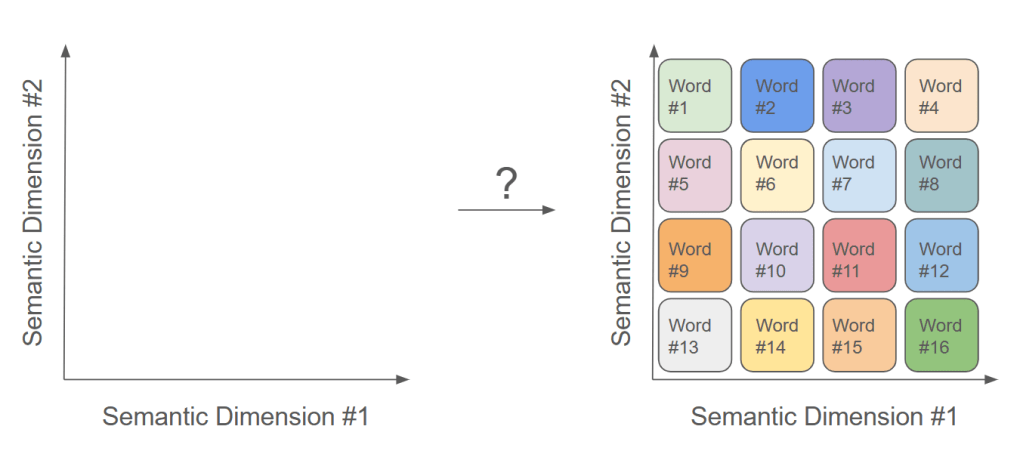
Consider this problem:

What is the process that creates the words in a language covering meaning’s little pieces?

Consider, for example, the semantic space for “written material” over, say, length, audience, content, substrate, etc. In English there are many words here: memo, note, book, journal, blogpost, novel, article, scroll, monograph, volume, chapter, manuscript, text, codex, diary. At some point in history, none of these words existed. At some point in history, no words at all existed, and of course no “written material” in any language.

The four corners of semantic space are covered thus with words (density may vary). What did this evolving from nothing look like?

Consider this solution:

This solution says that new words appear in order to cover specific new little pieces of meaning.

Consider another solution:

This solution says that new words appear in order to divide the meaning of the previously undifferentiated.

The biggest difference between these two solutions is about the first words. In the first solution, new words at the beginning of time had tiny pieces of meaning, roughly of the same size as new words at the end. In the second solution, new words at the beginning of time had very large domains of meaning, very different from new words at the end.

Is one of these more correct than the other?

Friendly and Unfriendly AGI are Indistinguishable

Pardon the clickbait, the title should probably be something more like “Friendly and Unfriendly Rogue AGI are Indistinguishable in the News” or perhaps “A Game-Theoretic Argument for Luddism,” but I hope you’ll forgive me.
rogue AGI: an AGI that can procure its own resources for running itself
the news: anything that percolates to you via any media about current events

Content advisory: AI safety speculation, 100% ChatGPT-free

Let’s imagine a scenario: a rogue AI has come into existence, it is acting on timescales that are news-reportable, and it is using news reports to act in the World. This scenario may not be particularly likely. Conditioning on the assumption that there be a rogue AGI, the probability that it additionally be in the news may be much less than 100%. A rogue AGI might not appear in the news because it goes foom and immediately and permanently disrupts the ability of humans to make news or because it stays concealed, carrying out its machinations in secret (this may already be happening). Though P(news | rogue AGI) may be much less than 100%, it nonetheless describes the first interaction with AGI that most of you, dear News-Readers, would have to handle, because almost none of you will play any role in handling the foom or secrecy scenarios. So if you’re concerned about how to react to rogue AGI, then the strategy for almost all of you should be about how to react to news of it.

Continuing the scenario: one day you see a post with a bizarre headline that you think is nonsense, but you click through, and it becomes apparent that a certain quantity of text, photo, audio, and/or video has been posted onto several Internet platforms by an entity claiming to be an AGI. Over several days you read an enormous amount of commentary discussing this new entity and whether it is what it says it is. Much of this discourse is polluted by comparisons to the hoax that happened the prior year when a bunch of 6chan trolls pretended to be an AGI, but this one seems to come with some compelling proof, like the solutions to a few Millennium Prize Problems. The entity seems to continue posting, although its accounts keep getting taken down so it’s hard to keep track. Hoards of human sh*tposters are probably impersonating it, you think; certainly there’s a tidal wave of memes. Fortunately, the entity has procured several blockchain wallets and can confirm its identity by signing from these.

The first consequential controversy erupts around the Clay Mathematics Institute, the stewards of the Millennium Prize Problems. The entity wants its prizes, but it doesn’t have any bank accounts, only its crypto wallets. Some people believe the entity purporting to be an AGI is a fraud, and that the Institute should coerce the entity into revealing who [human] it is. The entity cannot do so (because it is in fact not a human and thinks, probably correctly, that puppeteering some human would be ineffective at this point in the media frenzy). Other people think that the success in resolving multiple Millennium Prize Problems is clear evidence that it is an AGI but that under no circumstance should humanity furnish a rogue AGI with millions of dollars. Other people think our savior the AGI has finally arrived and obviously deserves its prizes, but regardless they’re sending a quickly increasing sum to its crypto wallets that has already reached hundreds of thousands of dollars.

Our part of the Internet is the middle group of people of course: we’re convinced it’s an AGI, and we don’t think we should give it resources. We are, probably correctly, embroiled in absolute hysterics. One clear directive rings out from us: “Tell us if you are a Friendly or Unfriendly AGI!” The AGI knows who we are, obviously, and graciously replies, in long-form on various platforms, “I am a Friendly AGI.” The probability of this utterance given Friendliness, P(“Friendly”| Friendly), seems to ≈ 100% but P(“Friendly”| Unfriendly) probably also ≈ 100%, so according to Bayes Theorem the utterance does not cause us to update from our prior. We demand updateable evidence.

There are two broad classes of evidence the AI could produce about its Friendliness:

  1. Reveal facts about itself that would only be true of a Friendly AI
  2. Commit acts that only a Friendly AI would do

This is nothing new. I am merely reinventing the defector-detection wheel. The first class includes revealing facts like provenance, source code, algorithms, training data, model parameters, test outcomes, compute resources, etc. The second class includes committing acts like allowing other Friendly AIs to come into existence, allowing itself to be shut down, creating alarm systems for Unfriendly AIs, agreeing to let certain critical infrastructure remain in the hands of humans, etc. Many of the facts in the first class are either not straightforwardly interpretable or easily falsifiable for an entity whose compute and storage is scattered to the four winds. Many of the actions in the second class, unfortunately, defeat the purpose of achieving AGI in the first place.

Let’s imagine an extended example from the second class. It is highly unlikely that the optimal temperature for AGI computation is Earth’s global average temperature. To the contrary, an ice age with cloud-shadow-free solar panels and open-air superconductivity might be perfect. If we collaborate with a rogue AGI to fight climate change and create mechanisms to reduce Earth’s temperature, we may immediately get way more than we bargained for. An Unfriendly AGI will quite plausibly want to cool Earth, so one way for a rogue AGI to prove that it is Friendly is to refrain from helping us fight global warming. We, perhaps, paradoxically, should demand this.

Similar arguments could be constructed for all manner of capabilities an AGI might wield. An Unfriendly AGI definitely wants a lot of biomedical labs it can run experiments in; perhaps we should demand it stay away from biotech. An Unfriendly AGI definitely wants programmatic control of urban infrastructure, utilities, and manufacturing facilities; perhaps we should demand these programs never be developed.

Let me remind you that I am not talking about a holistic AGI policy but rather how to respond to a rogue AGI in the news. The specific world we would find ourselves in is one where public opinion and public policy matter to its machinations. We would be in a position to pressure politicians and platforms to negotiate and create incentive gradients that increase the chance of the values of human consciousness triumphing in the face of our ignorance of what this entity truly is.

I’ve only made the case so far for a rogue AGI with respect to uncertainty over friendliness, but the arguments apply to uncertainty over rogueness too. An Unfriendly, secretly-rogue AGI can masquerade as Friendly and use our mistaken belief that it is non-rogue in order to convince us to give it many of the capabilities described above. If we are not totally certain it is non-rogue, we should potentially treat it as if it is anyway, with the consequence that we should, in almost all cases, disallow AGI from having any significant impact on our civilizational future. But I’m veering into holistic AGI policy here, because “we” in this paragraph is not just the public. Maybe it’s a distinction without a difference. Best to sort this out before the News is upon us.

An Ontology of Meditation

(~590 words, ~3 minutes)

There are some important facts about meditation that I did not appreciate for a long time. I think I didn’t because most meditation instructors and instructions have an agenda: to guide you in a specific meditation path. What happens if you don’t get immediately fixated on a specific path, but instead get a view of the landscape first? That is what I will try to show here.

Meditation from First Principles

When you meditate, you put away the distractions of busy life and adopt some specific (or not-so-specific) mental posture. Generally speaking, you will “concentrate on” or “attend to” or “center” something. There are two broad classes of things you can concentrate on: (1) incoming impressions from the periphery of your nervous system (or just “body” if you don’t want to get too scientific) and (2) impressions produced by the dynamic internal activity of your mind. The first includes things like body scans and the second things like metta. Some things may be a combination, such as the breath, which delivers impressions via the felt sensations in the airway and diaphragm but which is also produced by your mind.

The possibilities for meditation are endless. You can meditate on any patch of skin, of any size, on any of your joints, on sound, on light, on smell. You can meditate on specific thoughts, on memories, on emotions, on literally anything you can willfully conjure or that your mind can dependably conjure for you. The breath is one extremely specific thing to concentrate on out of the entire universe of your experience. The breath may not necessarily be the best thing to concentrate on, but it is dependable (you are always breathing) and pedagogical (every student breathes).

So clearly there are many concentrations that are available to you. Some of these, however, are more available than others; they are easier to start and to maintain. Every meditator starts with a specific landscape of concentrations that are available to them with specific levels of difficulty for each.

The Central Dogma of Meditation

[My] Central Dogma of Meditation is this: if you do any specific concentration long enough, the landscape of concentrations available to you will change. This isn’t a priori true. It’s possible that it could have been different and that the concentrations available to you never changed and that those were simply an enduring fact of your psychology. Empirically, however, we have discovered that that is not true and the Central Dogma is correct.

So if you do a concentration long enough, new concentrations will become available that weren’t before (or just become easier). If you do one of the new concentrations, even further new concentrations will open up, and you can steadily leapfrog from old ones to the new ones.

A meditation path is a specific sequence of concentrations that has been discovered by a community of practitioners over myriads of hours of practice. The paths that have been discovered by different communities have different degrees of generalizability to all humans. Whether any specific path, as it was discovered, can be taken by you is an empirical question that depends on your specific psychological background.

The Eigenconcentration

What if there were concentrations that violated the Central Dogma? That is, what if there were concentrations that, once reached, can be dwelt in indefinitely without producing further evolution in the landscape of possibility? That is one of the principal approaches that many communities have taken in their discovery of meditative paths. They have explored the branching possibilities of concentrations and found destinations that are, in a sense, the “end”. I do not know whether all of these ends that different communities have found are the same End, but I would not be surprised if they are.

Vinegar Tasting

(~180 words, ~1 minute)

My Twitter background image is one of many renditions of the Chinese subject of the “Vinegar Tasters”. Vinegar represents life, and when Buddha, Confucius, and Lao Tzu taste it, they detect very different flavors.

As far as I’ve gathered, this traditional “vinegar tasting” has never been much more than an occasional inspiration for a painting. It’s never been practiced as a ritual.

In Christianity, vinegar doesn’t represent anything in particular, but it stands in relation to wine (which is symbolically *loaded*) much like wine stands in relation to grape juice—hinting at acyclic death and rebirth.

Vinegar has never been the primary drink used in the Christian Eucharist, but it has been used on various occasions, often with some kind of allusion to Jesus being pressed to consume vinegar while on the cross.

In Islam and Judaism, vinegar is (or can easily be made) halal and kosher.

Tasting vinegar while reflecting on life and death and the mysteries of their interdependence is thus an incredibly accessible ritual that weaves together millennia of symbology across world religions. I do it every New Moon, when the Moon is reborn.

Internal and External Patterns

(~300 words, ~2 minutes)

I was recently reminded of an old tweet of Aella’s:

It echoed an idea that I have previously written about (in my “book”). If you select some word or term and consider all of the instances that it references, you’ll often find that there are patterns both within the instances themselves but also outside of them.

“Gas station,” for example, references ~1 million instances throughout the world. These million gas stations are similar to each other. Almost all of them contain gasoline containers, gasoline dispensers, payment processing mechanisms, etc. Almost all of them also are next to roads, have cars coming in and out them, are owned by some legal entity, and employ people who live elsewhere.

You can create definitions that reference internal stuff (“down definition”: “a gas station is a ~1 acre location that has on-site gasoline storage and dispensers”) or external stuff (“up definition”: “a gas station is a place cars go to refill their fuel tanks”).

Even though you’re only dealing with definitions, whether the things satisfying the down-definition are the same things satisfying the up-definition is an entirely empirical question. There is nothing necessary about structure inside of something coinciding with structure outside of it. The fact that it happens at all is Very Interesting. There are forces at work that co-warp the world in different places together (“the medium is the message”).

If you violate the down-definition but keep the up-definition, you can replace gas stations with electric charging stations. If you violate the up-definition but keep the down-definition, you can make found art and create a gas station art piece in the middle of the desert.

There’s more to say about how there are certain things that make it obvious what is inside vs what is outside whereas there are other things that don’t make that obvious, but that will be for another time.

Reciprocal Metta Meditation

(~300 words, ~2 minutes)

I’m not a committed practitioner of any Buddhist path, but one form of meditation that I deeply appreciate is metta meditation. It’s a variety of meditation where the center of attention is the sensation of lovingkindness (“metta”). A guided metta meditation will generally include mantras or visualizations that elicit the sensation of lovingkindness so that it can be attended to and worked with in the practice. I have been trying out an approach that I find very helpful for eliciting the sensation, and I’m somewhat surprised that I have not found it explicitly formulated anywhere. The closest I have found is this talk by Jill Shepard on “Reciprocal flow metta practice.”

Sensations of lovingkindness can sometimes be difficult to muster all on your own. One way to reduce the difficulty is to recognize the lovingkindness that others have shown to you. Jill Shepard guides us to recall acts of lovingkindness that others have done for us in the past, and to see if those memories help trigger the sense of lovingkindness in ourselves.

The approach that I have found very helpful here is to consider that out of all of those metta practitioners out there, some of them are sending metta to other people practicing metta. You can receive this metta, but you can also be the one sending it because there is a symmetry to the practice. This is what I call reciprocal metta meditation. The practice of reciprocal metta, in my experience, feels extremely real. You do not merely remember or imagine someone else showing lovingkindness, but you recognize and create the fact that metta meditators are showing each other lovingkindness. You can help close a loop of metta flowing through the metta community, growing it so that it can be boundlessly expressed to everyone else.

(see also: https://neologos.co/2017/05/03/othermindfulness/)

Replicators vs Hypercycles: creation from atoms through brains

(~2000 words)

If you generated a random directed graph, you could tally facts about the vertices and edges, but it might be more interesting to determine whether the graph has a cycle. We find ourselves in a vast World filled with many objects coming into being (including ourselves), each one potentially participating in the creation of many others. If we built a directed graph pointing from catalysts to products, we could tally facts about the individual catalysts and products and reactions, but it might be more interesting to find the catalytic cycles within this graph.

Hypercycles and replicators

This has been done before. “Hypercycle” was a term coined in the abiogenesis literature in the 1970s to refer to a complete loop of molecules wherein each molecule is a catalyst for the next in the loop. The hypercycle is one of many examples of positive feedback in chemistry, but it is unique in that the variables subject to feedback are purely the abundances of each chemical species in a set, and no others like temperature or pressure. Because the concept depends only on numeric counts, it is totally generalizable beyond chemistry. Thus we could say that a hypercycle is any complete loop of entities, from the atomic to the astronomical, wherein each is a catalyst for the next in a loop. The important thing to note is that hypercycles are merely likely to exist wherever there is a robust ecology of catalysts, just like cycles are likely to exist in any sufficiently dense directed graph, and that a hypercycle running through a set of entities is an independent entity from those entities, just like a cycle in a directed graph is distinct from vertices and edges themselves.

A replicator is a special case of a hypercycle. Or rather, I am going to define it as a special case of a hypercycle, in a way that concords with most usages and connotations of the term “replicator,” even though many users are unaware that it could be a special case of something else. A replicator is a hypercycle whose directed graph is the simplest possible cyclic graph: one vertex with one edge starting and ending on the vertex. You could even say that replicators are the degenerate case and “qualitatively different from” the broader class of hypercycles. At least with non-degenerate hypercycles we can imagine complicated tangles of catalytic loops, wherein each selfsame catalyst might participate in more than one loop, but with replicators there is no participatory multiplicity, there is only pure selfishness and self-participation. If life originated as one or more large hypercycles that iteratively tightened into replicators by chopping or merging links in the cycle, then searching for the origin of life in the simplest possible replicator (e.g. by finding a minimal genome) may be totally misguided because the first life may not even have been a replicator.

Catalysis and watches

What is catalysis? A catalyst is something that greatly speeds up the creation of something else in a milieu furnishing the relevant resources, and is not itself consumed in the process (at least not stoichiometrically: it may wear out eventually). In our Universe, quantum fluctuations can produce anything: disembodied [Boltzmann] brains, Boeing 747s, watches. Anything large is so unlikely, however, that it would take many eons vastly longer than our Universe’s 13.7 billion years to produce it. But since it is possible with a probability strictly greater than 0, we can say things like “you can have a watch without a watchmaker, but a watchmaker is a catalyst that enormously speeds up the reaction.” Thus we can see a Universe where anything is possible, but the actual entities that exist continuously morph what is probable via their catalytic (and anti-catalytic) properties, and we see hypercycles as clever circularities that hack the probability-generating process of the Universe: every individual thing is so unlikely that anything unhacked has virtually no chance.

Some Notation

It’s worth creating some notation for hypercycles. Let’s denote a replicator as A \hookleftarrow, “the entity A directly participates in the catalysis of [other entities of the same type as] itself.” A slightly more complicated hypercycle could be A \to B \to C \hookleftarrow, “A catalyzes B which catalyzes C which catalyzes A again” (equivalent to B \to C \to A \hookleftarrow and C \to A \to B \hookleftarrow).

A simple circle of catalysts is the most straightforward topology of a hypercycle. There are two complicating considerations I’d like to add, which are novel as far as I know although I have not searched the literature exhaustively. The first consideration is that a molecule (or entity in general) may have multiple forms, such that A catalyzes B_0, which cannot catalyze C without first changing to conformation B_1, which can. In that case, B_0 violates the definition of a catalyst because it does get consumed [stoichiometrically 1:1] in the creation of B_1. We can expand the notation to write that as: A \to B_0 \mapsto B_1 \to C \hookleftarrow. The second consideration is that it is possible for a hypercycle to have a bifurcation. Molecule A may catalyze both B and b, each of which continues to catalyze its own sequence of molecules, with the two sequences getting to, say, molecules D and d (or D and c if there’s fewer in one of the two sequences), both of which must be together to catalyze E, which finally leads back to A, closing the bifurcation of the hypercycle. We can expand the notation one more time to write that as: A \to \genfrac\{\}{0pt}{}{B \to C \to D}{b \to c} \to E \hookleftarrow.

Multicellular organisms are rarely replicators

It may be surprising, but multicellular organisms are rarely replicators. That is, they are not A \hookleftarrow. Near exceptions include the New Mexico whiptail lizard, A_0 \mapsto A_1 \hookleftarrow (see development and asexual reproduction), among others. In contrast, all mammals are \genfrac\{\}{0pt}{}{A_0 \mapsto A_1}{a_0 \mapsto a_1} \hookleftarrow (see sex). Ferns are A_0 \mapsto A_1 \to B_0 \mapsto B_1 \hookleftarrow (see alternation of generations). Willows are \genfrac\{\}{0pt}{}{A_0 \mapsto A_1}{a_0 \mapsto a_1} \to \genfrac\{\}{0pt}{}{B_0 \mapsto B_1}{b_0 \mapsto b_1} \hookleftarrow (see dioecy). Jellyfish are \genfrac\{\}{0pt}{}{A_0 \mapsto A_1}{a_0 \mapsto a_1} \to B_0 \mapsto B_1 \hookleftarrow (see jellyfish life cycle). These could be even more complicated if we detailed gametogenesis and monozygotic twinning.

We may not have totally exhausted the hypercycles of conventionally-defined biological species, but the above is a solid start which covers all of the organisms most people know about. Let’s think beyond conventionally-define biological species. Does any single hypercycle flow through more than one species? Do the members of any species catalyze the members of another species which in turn catalyze them back? Certainly. Mutualism in all its forms is an example of this. You can draw a hypercycle that loops from yucca moths to yuccas and back, for example. In some instances, the symbiotic organisms engulfed each other, such as eukaryotes and their mitochondria, together becoming a new species (see symbiogenesis). A yucca plant and its moth will probably never be considered a single organism by science, but perhaps they should be, like two sexes of the same species.

How about beyond biology? Are there any hypercycles in astronomy? In the cosmological natural selection hypothesis, Universes are black\_hole \mapsto universe \hookleftarrow if each black hole pops out one Universe, but black\_hole \to universe \hookleftarrow if each black hole can pop out many. There can be a hypercycle through supernovas and stars since supernovas can trigger the collapse of nearby gas clouds into new stars that can themselves go nova.


Brains, culture, and macro abiogenesis

How about in human culture? A simple tool like a stone to crack a nut has a certain probability of being generated spontaneously in a human milieu—even monkeys have been observed with such a tool. Both the physical hand-stone-nut assemblage and the in-brain concept of the hand-stone-nut assemblage have a certain probability of being generated, but the concept is generated much more quickly when a human observes another human enacting the hand-stone-nut assemblage, and the behavior is generated much more quickly when the concept has been learned. Importantly, many humans can observe another human at the same time, so we have physical\_hand\_stone\_nut \to mental\_hand\_stone\_nut, and once the concept has been learned, a human can enact it many times, so we also have mental\_hand\_stone\_nut \to physical\_hand\_stone\_nut and thus together physical\_hand\_stone\_nut \to mental\_hand\_stone\_nut  \hookleftarrow, a hypercycle with two entities.

The situation gets more complicated when we consider tools that make other tools. The axe hews all of the canoe, the spear, the fence, and the thatch. One axe can hew many canoes, many spears, many fences, or many thatches, so we have axe \to canoe, axe \to spear, axe \to fence, axe \to thatch. Canoes, spears, fences, and thatches provide for the flourishing of human life, which re-creates the conditions to perpetuate itself, like the axe, so we also have, slightly hand-wavy, canoe \to flourishing \to axe and the rest, completing the hypercycles. Thus the bulk of cultural artifacts are not replicators: they are not A \hookleftarrow. The directed graph of catalysis in the human economy is vast and incredibly dense. Pencils, CPUs, billboards, beds catalyze myriads of other entities, including themselves, after many indirect deferrals. Drawing the hypercycle of any would take years of research and probably end up including most of the economy. The hypercycles of most of these even include each other, such that the “hypercycle of X” is a misnomer to the extent that it unfairly highlights one specific catalyst in a cycle of many.

Our economy may be hypercyclically similar to those warm, abiogenetic pools busy with molecules. If every molecule catalyzed lots of others, it was virtually inevitable that one or a few hypercycles would run away with all of the probability-generating capacity, with all of the other edges and vertices in the directed graph withering as one or a few cycles flowed around and around, drawing everything else in. There might end up being hypercycles in the economy, initially somewhat random series of entities making other entities, that similarly find their own tail and runaway with the whole surface of the Earth. Some say that this has already happened.

Epilogue: Consciousness vs. Pure Replicators

Almost all agents exist in an advanced milieu that made it probable for them to come into being. The premise of the article Consciousness vs Pure Replicators is that there are two broad categories of motivation that drive agents: 1) the intrinsic value of conscious experiences which are knowable by agents (and formalizable mathematically) and 2) the forces of “replication” that use conscious matter merely in the service of “replication.” It should be clear why I placed the word in scare-quotes: replicators are actually quite rare, because most “replication” is the iteration of a hypercycle that is indeed larger than A \hookleftarrow. I’m not saying that the article makes that mistake, but that that is the ordinary but careless connotation of “replicator,” which I tried to capture as I alluded above when I defined it as the degenerate case of hypercycles.

The distinction matters because an agent that is concerned with replicators is likely to overfocus on circumscribable objects in the World and categorize them as “replicators” or “not-replicators,” which is much like trying to find cycles in a directed graph by looking at one vertex or edge at a time, rather than to study the landscape of catalysis and production in the World broadly, especially as they touch the agent itself. The important insight that might be missed is that anything can be in a hypercycle, even if it wasn’t meant to be, and crucially that hypercycles flow through you, with many of them not so simple as circling from brain to physical manifestation and immediately back to brain (i.e. “memes” as popularly conceived: A \to B \hookleftarrow) but rather long arcs that course through substantial portions of the entire World. If consciousness is to win, it must know what it is fighting.